“Mom, you go first,” she said with confidence.
So I did, and as I looked back at her, I knew times were a-changin’.
The weather was beautiful and the snow was perfect. The slopes were glistening and we were skiing together as we had for the past 25+ years. This year’s ski-adventure started out like all those that preceded it. We arrived at the lift-line a few minutes prior to opening. We secured boots, strapped on helmets, slid on gloves, and clicked into our skis. Moments later, we hopped on the first lift and headed up the slopes. Throughout the initial ride, we chatted briefly about our ski-history . . . the times we had been together on this particular lift . . . the weeks we spent as a family skiing . . . all of the traditions of the past. We smiled because here we were doing it again – skiing for a week, and it was only day one.
Over those past 25+ years, I have learned that she prefers skiing in wide open spaces, in light fresh powder, the faster – the better. Steep downhills don’t phase her, nor does skiing over ice in cold, cold weather. In fact, she is an excellent skier – with the skill and ability to maneuver most any terrain.
At the top of the slopes, we plotted out our first runs – something a little easy to start the day. And for the first hour or so, we traveled back through some of our favorite ski-haunts – pushing powder here and there – gliding and sliding – laughing and chatting.
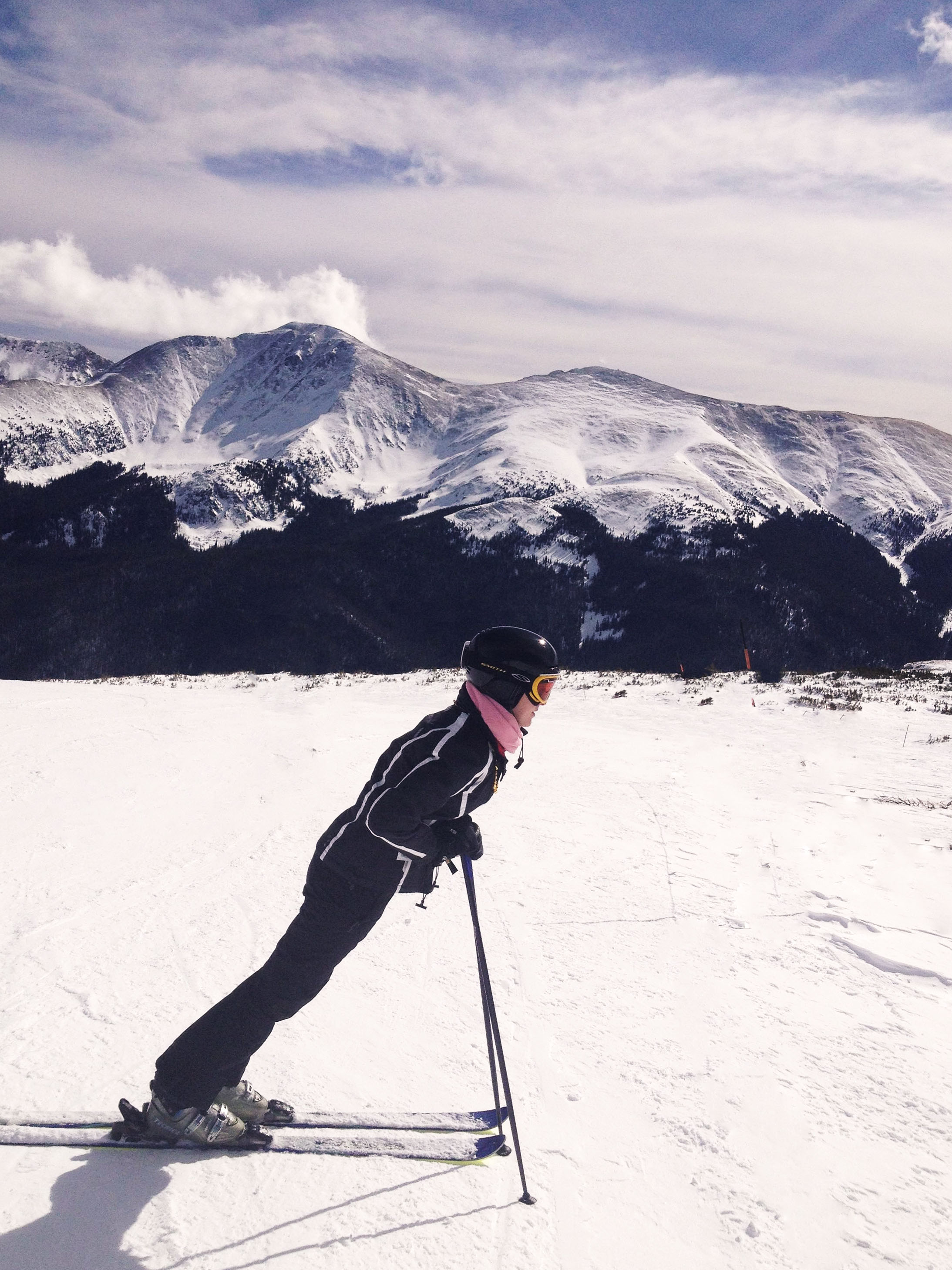
Finally, we decided to move on to bigger and better runs – something a little more challenging. With the snow conditions perfect and the sun shining, we opted to head to up to the top – to the summit – to see the sights and ski with gusto. A smooth six-person lift took us up. Once off the lift, we stood in awe of what we could see. We were slightly above the treeline – and the Rockies stretched out in front of us for miles and miles and miles.
And there we were paused – looking, watching, thinking – with the feeling that we were standing on top of the world. What we could see was so spectacular that skiing itself took a backseat to the scenery surrounding us. During that moment, time just seemed to stand still with the only sound heard best described by Robert Frost as “easy wind and downy flake.”
“Mom, you go first,” she said with confidence.
So I did.
The slope in front of us was actually a little dicey. Most of the snow at the top had blown off so we were starting out on ice. The second section had been well-skied by others, creating a few navigable moguls. Oddly enough, 500 feet from us, the ski patrol was assisting a young man who looked like he had an unfortunate meeting with a nearby tree. The final section would take us through glades and glades of evergreens until the run flattened out near the bottom.
Skiing is an interesting sport. Any great resort will have terrain for everyone – accommodating both beginners and experts and everyone in between. Most runs have an easy way to the bottom and a challenging, more exciting way as well. Skiers judge their own ability and choose their own paths.
Throughout our ski history, we have always skied following a simple rule – an unwritten and an unspoken one – but a simple one. The strongest skier goes last. If those in front of the last skier encounter challenges beyond their abilities, that strongest skier is a tremendous asset – having the skills to not only self-navigate, but to help navigate others when necessary.
In past years, more often than not, I was the last skier. There were many times when I hauled my children out of ski-misadventures – following them down slopes that were well above their abilities, chasing them down paths through snow-covered trees, fetching runaway skis, and pulling them out of piles of snow after a fall. The last skier.
But with those four simple words, I knew that the times were a-changin’.
I glanced back and saw her standing, confident and proud. She was perched just a few feet away from me and used her ski pole to casually point towards a solid direction that we should take. I nodded equally as casually and pushed myself slightly over the icy start.
The only sound I heard at that point was the swish of my own skis. I knew that she was waiting above me – as I had done for her so many times before – patiently and appropriately, making sure that I wasn’t going to encounter any problem or challenge. It was her turn now and my turn to let her have a turn.
Out of the ice, I hit the short section of moguls, and headed for the trees. I stopped for a brief second and heard snow spraying off of her skies when she stopped immediately behind me. Though nothing outwardly had changed – we typically stopped throughout any ski run, just for fun, laughing, resting, smiling – inwardly much had changed.
Everything in life has its own season, and though my initial response was to delight in seeing her move into a different one, it was also about delighting in my movement as well. I now had another person in my life who was following and watching over me, someone to follow me through my misadventures and fetch my runaway skis. It was the changing of the guard in a part of my life, and all I could think about was all the crazy-fun that would lie ahead for me and for her.
We finished the run with little to no fanfare – which is great when skiing – and hopped right back on the same lift to experience it – one more time, again.
The You Go First Moment
(P.S. – I have been absent from my blog for awhile, but am glad to be back!)



 Deborah Hutti