Gotta Love Winter Break

I love winter break.

And, I am happy to report that I have had a winter break every year of my life since I was in kindergarten.  Really – what’s not to love about it –  ten days off each winter from sometime before December 25th to sometime after January 1st.  A brilliant idea in any world.  It can be called winter break or winter holiday or semester break or just plain vacation; regardless of the name, it is still grand.

Winter break is one of the joys of the United States educational system.  Everyone and everything stops – halts – pauses for a holiday.  No one misses anything because there is absolutely nothing happening to miss . . . for ten days . . . at the end of one year and the beginning of the next.  There are no classes scheduled, no meetings to attend, no educational dilemmas to solve.  The phones may ring and email may be received, but all of it waits until the holiday ends and the next semester begins.

Winter break is one heck of an educational tradition.  Sports-metaphorically, it’s halftime for folks on both sides of the classroom.  Officially, we claim that its purpose is to re-invigorate ourselves, recharge our brains, and prepare ourselves for what follows in January.  Of course, those reasons are all true; however, behind the scenes, winter break is also a time to simply goof around during what can be the gloomiest time of year – in particular for those living in the colder and snowier climates.  Some say why, while those in education say . . . why not take a break.

Not only is winter break an educational tradition, but so, too, is spring break, and fall break, and of course, summer break – with the last being the longest and strongest both in tradition and duration.  Obviously, education isn’t shy about its official pauses.  It’s a glorious schedule . . . work a little, rest a little, work a little, rest a little, work a little, rest a lot.

There are serious challenges to working in education, (and I will leave those issues for discussion by someone else at some other time); but, taking and enjoying break time isn’t one of them.  How to holiday is an art form that has been heartily practiced and universally adored by students, faculty, staff, and administration throughout all education.

This winter break, I have noticed two distinct reactions by folks outside of education.  The first I take as a compliment – although it generally comes in the form of questions with twists of sarcasm:  When do you work?   Are you still off?  When do you go back?  Is anyone manning the ship while the students are away? Who is paying for all of this?

And, truly, from the outside, it must look like education is break-happy beyond belief.  In fact, I am careful not to contact my dad too much during winter break, as he is old-school.  Prior to his retirement, he worked from dawn until dusk without even as much as a fifteen minute break.  Lunch was on the fly and a vacation was earned and given during the summer months only.   So, regardless of sarcasm, this reaction to winter break is well understood and well deserved.

The second reaction I also take as a compliment, but it is much more quizzical to me:  I wonder why I am not off?  Why isn’t everything closed for a winter holiday?  Shouldn’t it be a part of world tradition to take scheduled breaks? 

Here I can only empathize and whole-heartedly agree.  These questions seem to be directed more internally towards those who are not partaking in break time rather than externally towards those who are.  Yes, everyone should pause.  Yes, everyone should re-invigorate, recharge, and prepare.  And yes, everyone should have a length of time in the middle of the winter to goof around.  The only challenge is convincing the entire non-educational world to institute the winter break system immediately each and every year.  A possibility?  Yes.  A probability?  Hmmm . . .

My itinerary this winter break was typical for me, I think.  I spent time with family and friends near and far; I completed household projects put on hold throughout the fall; I caught up on day-to-day tasks, wrote thank you cards, worked out at the gym, cleaned closets and cars, read my backed-up reading list, wrote a new bucket list, watched basketball games, went to the movies, ate too much, and slept too little.   In reality, the list of my winter break accomplishments is a lot of nothing plus a little of everything that could have been postponed if it weren’t for the great winter pause.

Yet, I love winter break.

Regardless of how mundane and inane my accomplishments have been during break, it is crazy fun.  It is crazy fun to rejuvenate and recalibrate in any way, even in ways small and silly –  especially when facing the dark days of winter.

Interestingly, one part of my winter break activities included being in a car during the early morning hours on December 25th. From my bird’s-eye view, most – if not all – folks appeared to be on break at least for the day. All businesses were closed and a true winter break seemed to be in full swing. The roads were quiet and calm with no traffic in sight and no sounds to be heard.  Everyone was on pause.  For me, it was a surreal moment thinking that more than just the education population was taking a winter break . . . together.

My take-away? As a nation, we should seriously strive for the winter break concept.  Take what happens in the halls of academia and generalize it, so that those whose fortune hasn’t led them to work in education are able to experience the true meaning of holiday.  I have no clue as to whether I am a more productive and/or effective educational employee because of winter break.  It is hard to measure as there is no control group inside education to use for comparison!

However, it is easy for me to know that winter break is just a plain good idea.  So, here’s hoping that we all pause for ten days next December/January . . . together.

It doesn’t hurt to hope!

This photo was taken moments before the official start to winter break!

All I Can Say Is Here’s to the Crazy Ones . . .

Here’s to the crazy ones . . . the misfits . . . the rebels . . . the trouble-makers . . . the round heads in the square holes . . . the ones who see things differently.  They’re not fond of rules, and they have no respect for the status-quo.  You can quote them, disagree with them, glorify, or vilify them.  But the only thing you can’t do is ignore them . . . because they change things!  They push the human race forward.  And while some may see them as the crazy ones, we see genius. Because the people who are crazy enough to think they can change the world . . . are the ones who do.  

– – Apple Computers – –

As I look back on my early life, at times, I think I grew up in a world of conformity.  The Pleasant Valley Sunday syndrome (my favorite 1967 hit single by the Monkees) described my neighborhood.  Rows of houses that were all the same lined my street.  Most – if not all folks – were of the same race and religion.  Each household had a dog, at least one Schwinn bike, two aluminum trash cans, a front lawn light that was turned on at dusk / off at dawn, a postage stamp sized back yard, and curb-side white and black painted house numbers.  A typical week included church on Sunday, school Monday through Friday, and barbeque on Saturday.  Dinner time was 5:00 o’clock – for the entire street.  School uniforms – the gray plaid wool variety – were the norm.  Being the same was in vogue.

In my youth, being the same – having a little bit of conformity –was somewhat comforting.  Bedtime – 7:30pm every night.  Television’s Wonderful World of Disney – Sunday night.  Fish sticks and tater tots for dinner – the Lenten Friday night special.  From kindergarten to eighth grade – recess at 2:00p.m.  And every weekend, it was radio time:

Here we go with the Top 40 hits of the nation this week on American Top 40, the best-selling and most-played songs from the Atlantic to the Pacific, from Canada to Mexico.  This is Casey Kasem in Hollywood, and in the next three hours, we’ll count down the 40 most popular hits in the United States this week, hot off the record charts of Billboard magazine for the week ending . . .

– – Casey Kasem – –

Listening to the American Top Forty fifty two Saturdays out of the year was only one of many rituals.  We did many things the same way at the same time with the same people; and, this behavior created more than just a system of status quo. It built a framework of traditions and customs that are still alive and well today. It added significant stability to daily life.  It taught me and the world around me a lot about the importance of patterns and the power of expectations. It created a solid level of security.

And through such a cozy life of conformity came the graceful ability to become the ones who saw things differently . . . the misfits . . . the rebels . . . the trouble-makers.  Many of us became so rather easily by combining what we knew about conformity with what we didn’t know about being the crazy ones.

Think of Johnny Cash.  He only wore one color – his trademark head to toe black.  He obviously knew the value of consistency and reliability . . . of conformity.  His audience expected him to wear black and he did.  But the Man in Black’s career was rebellious for sure.  His music spoke to challenging issues within religion, within justice and the prison system, or within human sadness.  He sang the tunes of change, but ironically enough,  started every performance with the same statement: “Hello, I’m Johnny Cash.”

Think of Harriet Tubman.  She was one very rebellious woman during her time of advocating for the end of slavery.  Words used to describe her include abolitionist, reformer, activist, and (my favorite) spy – all the language of the crazy ones.   Yet, it is interesting (and horrifying) to me to know that she started her early life out as a slave – a life that I am sure required great conformity in order to survive.  To be a slave meant holding together the status quo in order to avoid death or near death.  But, as the Apple saying goes, she never allowed folks to ignore her.  Quite the opposite –  for she was a crazy one, the round peg in the square hole calling out and demaning change.

All I can say is . . . here’s to the crazy ones.

Here is to the person with the great idea of painting the house pink in a neighborhood of white frame homes.  Here is to the family who didn’t eat dinner at 5:00p.m. sharp.  Here is to the folks who look at today’s technology and think of new and different uses with the idea that they may be the ones who harness the power of some type of gizmo to solve challenges like poverty and hunger. Here is to the young women and men who look at the solution to cancer differently than their predecessors in hopes of eradicating suffering and pain for the masses.

And thank goodness the crazy ones won’t let us ignore them.

I thank my lucky stars that the glory of genius allows . . . well . . . geniuses to stand out in a crowd.  The more the world sees and hears the mantra of their ideas, the more likely we will listen.  And the light should not just be shining on the genius of Apple, Disney, AT40, Cash, or Tubman.  It should be burning bright within everyone – within the framework of the conformity that provides stability for the emergence of change.

I only hope and prayer that folks see my children, my spouse, my family members, friends, and myself as part of the crazy crowd.  And I am hoping that the lessons taught through moments of conformity translate into strongholds of opportunities to ensure that when faced with a moment to change the world, I can.

The Pearl Harbor Firefighters

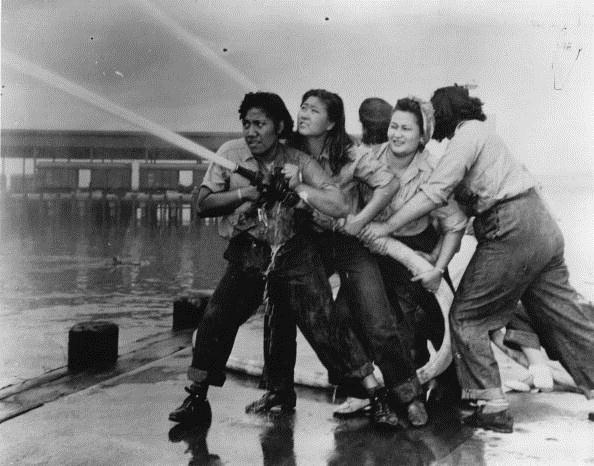
WOW.  I look at this picture and am speechless.  WOW.  There are certainly a thousand words in me that describe what I am thinking, feeling, seeing when looking at this photo, but the first word coming to my mind is . . . WOW.

WOW.  The sirens must have been blaring . . . fires roaring . . . death and destruction surrounding all. For all I know bombs were still falling.    The sky above looks to be full of hazy smoke, most likely residual from the deadly attack.

Though the three faces that I can see look intent, it is the hands of all the women that truly show intensity.  All fingers holding onto a 1941 fire hose with all the power they found deep within themselves.  Side by side each hand forming a chain of strength enabling the women to hold on . . . tight . . . knowing that their success could save lives.  WOW.

And the courage of these women.  Their ‘caution to the wind’ actions – working to save the lives of others while their own lives could have been in danger – shows courage.  Their fight to contain a stronghold on a monster hose knowing quite possibly that their physical strength only existed due to their number – shows courage.   Their desire to help those in distress – placing their own needs second – shows courage.  I often wonder what my response would be . . . only hoping that I would be a person capable of fighting fires.

Their faces are mesmerizing.  Their eyes seem to be willing the stream of water to reach its destination.   Their jaws are rigid with determination, desperation.  And though the ground below their feet appears to be slippery and unstable, their legs are planted firmly, muscularly on the dock, no trembling or quivering . . . hoping against hope to end some type of eminent suffering . . . to bring some type of calm to the firestorm. WOW.

Within twenty-four hours, President Franklin D. Roosevelt addressed the nation telling all that December 7th, 1941 would be “a date which [would] live in infamy.”  2,401 Americans were killed.  1,282 were wounded.  188 U.S. aircrafts were destroyed.  Family members, friends, colleagues, co-workers, and buddies – all walks of life were among those who perished.

Though I was not alive, I am sure that the United States stood still on that day . . . at that time . . . at that moment.  And although there is plenty of movement in the photograph, to me it renders an eerie, chilling stillness.  It is a quiet portrait, wordless.  The women are frozen in time, perched on the edge of the harbor, working with dazzling silent commitment.

WOW. I stare at this image and my mind wanders to what may have happened in the frames before this shot or what may have happened in the frames after it.  How did these women assemble?  Who called them to this duty?  Why them?  What was the chatter among them?  What were their skills . . . their strengths?

For some reason, after a good length of gazing at it, I want to know their names.  Who are they?  Where are they now?  What was their connection to this particular moment other than being in Pearl Harbor on December 7th, 1941?  What doesn’t this photograph tell me about them?

So often as tragedy strikes, the sharing of detail is too difficult.  Sometimes, it is only through pictures – like this one – that those of us on the outside catch a glimpse of what those folks on the inside experienced.  The United States may be blessed to have this piece of history as documentation of the attack on Pearl Harbor – for part of infamy is remembering a moment such as this, for better or for worse.

Interestingly, the composition of the Pearl Harbor firefighters reminds me of another popular photograph: Raising the Flag on Iwo Jima.  A Pulitzer Prize winning photo taken by Joe Rosenthal in 1945 during the Battle of Iwo Jima, it depicts six United States soldiers raising the stars and stripes in victory on Mount Suribachi.

The two photos were taken less than four years apart – one in agony and one in victory.  Both capture heroic actions – one on the part of a group of young women and the other a group of young men.  Each photo defines what I consider to be patriotism . . . our drive to protect freedom, our concern for each other, and our common goals as a nation.  Today – both photos are inspirational: they are true commentaries on the American spirit.

Though I was a very young child at the time, I have often heard, studied and can recall the words of President John F. Kennedy via his inaugural address in 1961 – a mere twenty years after the attack on Pearl Harbor:  “Ask not what your country can do for you, ask what you can do for your country.”   These words often give me guidance as I work through the challenges of daily life.

As the challenges unfolded on December 7th, 1941, I can’t imagine that the women in the photograph had any time to ask themselves or anybody else what they should do. No time for conversations or debate. Rather, I have a feeling that some type of instinct drove them to the precipice of the harbor, directed them to find a way to battle the torrent blazes around them, provided them with the courage to persist, and encouraged them to stand firm in their attempt regardless of the horrific circumstances of the day.

I just thank my fifty lucky stars for what these women did for their and my country.

Old Fashioned Is Always In Fashion

I am solidly old-fashioned.

Nothing better to me than a sharpened, yellow number two pencil and a spiral bound notebook.  I like the Slinky, red lifesavers, manual umbrellas, shredded wheat, PF Flyers, and acoustic guitars. I would rather watch a good episode of Leave It to Beaver followed by Mister Ed and Ozzie and Harriet than any of today’s new-fangled reality TV shows.    I buy a new broom at the local broom-corn festival each year and use it to sweep the garage floor over using an electric shopvac to complete the same task.  A month ago, I bought a case of glass bottled SKI soda – an old-fashioned thirst quenching classic.

Old fashioned stuff is durable.  I have owned . . . and I still use . . . the same grey metal, non-mechanical three hold punch gadget since the late 1970s.   I am not saying that I use it daily, but it hasn’t collected much dust over the years, and it’s in perfect condition.  And forget the all-in-one Black and Decker laser level that has twenty additional functions beyond maintaining a straight line, my household is the proud owner of a 30-year-old red three-foot steel version.  It’s just a level – no bells and whistles – that has been dropped off many ladders, left out in the great outdoors for days, and often lost in a crowded garage.  Yet, it still works.

Proudly, I have only owned one rolling-pin though I have owned several kitchens; I have had the same key ring for a couple of decades; and, I am a one jewelry box per lifetime type of gal. Keep in mind that all of this has nothing to do with being frugal.  It has more to do with just liking things they way they were. Old-fashioned.

Same for my language.  Sure, I could use all of the latest and greatest lingo, including the more salty versions of yesterday’s banned language.  But, I still stick with the tried and true slang that has helped to get me to this point without too much trouble.  Groovy, righteous, awesome or bumble head, holy guacamole, yikes – multipurpose old-fashioned words that seem to fit well into all kinds of conversations.

And I have found that old-fashioned almost always equals crazy funny.  One of my relatives fixed and ate a fried bologna sandwich at my house recently.  For those of you who have not had the experience, fried bologna is an ancient delicacy first created by . . . probably Mr. Oscar Mayer himself in some long ago century.  Thirty seconds in a skillet, paired with white bread and catsup, this sandwich is a comedic display of old-fashioned in motion.  It is a chuckler!

And no game is as crazy funny as good old-fashioned Spoons.  Honestly, I have played several of today’s XBOX/WII/KINECT 3D video games, and they are fun.  But, Spoons!!! Played with a deck of cards, a handful of spoons and a bunch of crazy funny relatives, this game reaches deep into the crazy funny well. No laughs greater than when full-grown kissin’ cousins jump over a table to pull coveted spoons out of challengers’ hands during a family ‘friendly’ version of this game.  Another old-fashioned chuckler.

I often tell myself that I don’t understand the lure of the old-fashioned for me . . . that this old-fashioned fascination is a mystery.  But, when I really think about it, I know for sure that the draw towards old-fashioned isn’t simply due to a preference for card games, or food, or language, or frugality.  It’s more than that.

With every generation, there seems to be a strong penchant for change . . . from clothing styles . . . to modes of transportation . . . to energy sources . . . to an endless list of activities and items that have been reinvented, improved, changed.  Life today is significantly different from life in any other moment in time. Certainly, almost all changes have  been positive and welcomed and for the betterment of all humankind.

Yet, there is a part of life that I believe should remain constant . . . a part of life that should be considered a masterpiece, a part that should somehow be exempt from change.  Certainly that includes the lapping sounds of the ocean waves and the majesty of the highest mountain peaks.  It includes the freedom enjoyed by animals in the wild and the beauty each year of summer, fall, winter, and spring.  It includes quiet skies and peaceful meadows.  I know it includes the brilliance and genius of those who have gone before us along with the brilliance and genius of those who are still in our future.

Thus, however, explains my penchant for everything old-fashioned.

I may have to change the form of my telephone from a hard-wired, LAN line cordless system plugged into the wall to a cellphone carried in my coat pocket.  I may have to heat my home with solar, geothermal, and/or wind rather than the current fossil fuels available.  And I may have to give up the tried and true General Mills Wheaties – the breakfast of champions – for a more nutritious protein bar option.

But, for those few things that I can somehow manage to hold constant, I am on-board.

Bring on potato pancakes and King Bing bars.  Give me a pile of leaves and hand me a rake complete with a wooden handle and steel prongs.  Let me haul out box after box of old crazy funny holiday decorations that have lasted multiple decades because they were made in the days of the giants.

Finally, hand me a dented red level to keep me headed on the straight and narrow any day of the week.  And watch my willingness to change grow as I find comfort in keeping some things . . . just a few old-fashioned things . . . in my life constant.

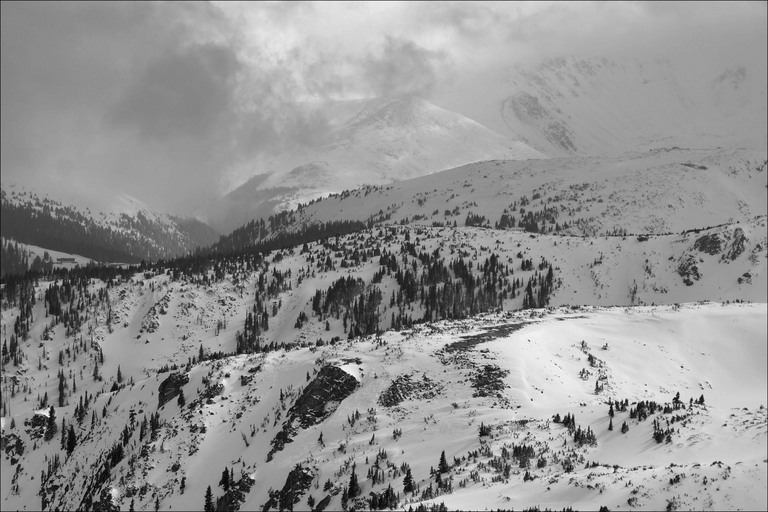
The Rocky Mountains . . . An Old-Fashioned Constant