Unexpected Kindness: Lessons from New Melleray Abbey

Featured

Autopilot.  It is a feeling that I think most of us have either felt or certainly understand.  And there we were on autopilot.  

We were going through the motions of life, completing the hundreds of tasks that needed to be finished, but in a very unknowing, automatic way.  Those around us – both far and near – were helping us move along.  Our son , Matthew, had died and it was now time to figure out every next step that has to be figured out when a loved one journeys on.

I actually have no recall as to the details on how we learned about the New Melleray Abbey except I know that our dear friends – whose son, Torre, had sadly journeyed on many moons before – graciously forwarded the information somehow to us, and we miraculously received it.

To this day, I am still unsure how that transmission transpired. For during this time, I was not making or taking phone calls.  I was not reading or sending email or checking any social media.   We barely answered our door.  But we still had to make all the decisions and choices that all families make in the same situation as ours.  And as we all know, it is hard.

December was ending and January arriving, and the weather was exactly what that time of the year brings.  Freezing temperatures. Moments of snow.  Some moments with nice peaks of sun. Some moments with ice everywhere.  And a stillness that comes with all that is winter. 

The holidays were in a crescendo as the world prepared to celebrate the new year. It truly seemed as if I were living the words to Robert Frost’s “Stopping by Woods on a Snowing Evening” with many promises to keep and miles to go before we finished our sad task.

We called New Melleray Abbey.  Their prayerful efforts, their spiritual intention, their focus on quality in both their handiwork and in their godly work felt so appropriate for what we wanted. Our friends guided us to them and they were so correct in doing so.  When we called the Abbey, there was a developing snowstorm in Peosta, Iowa. Plus it was the beginning of the New Year holiday.  

Though we felt it would be a right fit for Matthew, there were circumstances well beyond our control.  Travel and delivery in our timeframe was simply impossible. The Abbey knew it and we knew it.  There was little that any of us could do or say.  We thanked the Trappists Monks in our call to them and understood that we needed to make alternative plans.  

Within fifteen minutes of ending that conversation, we received just one more call.  It was the New Melleray Abbey.  They had done some pondering. They wanted to help. Though delivery was impossible via their regular over-the-road trucking service due to timing and weather, they had another solution.  Leaving from Peosta, Iowa immediately, circumventing weather and graciously sacrificing the New Year holiday, an individual from the Abbey would be able to use their own Ford 350 to complete delivery just in time.

And the Abbey did so, and when delivery occurred, we did not have the opportunity to meet, see, or thank the person who so thoughtfully helped us.  I knew nothing about the particulars or the driver who so graciously journeyed to our town to help us.  Nothing.

For many of us – me included – there is something challenging . . . something difficult . . . in accepting help, any kind of help – even when it is so needed and necessary.  It is even more difficult to accept help – needed and necessary help – from an unknown source . . . from someone who is not a family member, who is not a close friend, who I may have never met.

I have always been proud of being relatively self-sufficient, of being able to generally fend for myself and take care of most of the challenges that crept up in my life.   As I have grown up, I have learned to be comfortable relying on my husband or my children or a handful of close family members and friends who have graciously helped me throughout my life. 

This circumstance was different. 

A stranger to me – a complete stranger – went truly above and  beyond.  I had to learn to be willing to and humble in accepting assistance without the ability to reciprocate in any way.  I had to understand that I needed help, that it was being offered, and that it was coming from a source hundreds of miles away. 

The New Melleray Abbey had found a solution to our situation. They considered the less prominent solution, the more challenging solution, the one that was going to be most difficult for them in all ways, and went for it.  They didn’t allow me to fixate on the barriers that I was seeing.  They looked beyond those barriers and created a whole new strategy. 

The New Melleray Abbey simply would not accept my inability to creatively resolve what seemed to me to be insurmountable circumstances.  Instead, they looked kindly and determinely past me and continued with their plans.  Full speed ahead. No stop. They set a powerful example on what true kindness means. My role – watch, listen, learn.

Thank you, New Melleray Abbey.

The Work of the New Melleray Abbey

Oh, Deb!

“Oh Deb, stop being so naïve!”

Those six words.  Those impactful six words. 

They were mad mumbled many many moons ago.  There I was a relatively new academic administrator at a rural community college.  I was happily dancing in a world of teaching and learning having crazy-fun.  Everything was exciting.  Everything was interesting.  Everything had an air of college importance. I am not exactly sure of my stage of newness. But, I can say that my work world was full of just pure joy at every turn. 

At that point, there was a problem cooking on campus.  It was in my area of responsibility which was a bit large at that time.  The problem was a bit more than challenging and a bit less than catastrophic. Meaning that the world of student learning was not going to come to a screeching halt, but it was going to be impacted enough to bring the challenge to the attention of several levels of leaders . . . including me. My team was up to bat and I was in the line-up.

 As the newest kid on the administrator block, I was armed with a million ideas all of which I thought were tremendous and about a teaspoon full of experience. It was an incredible moment for me and probably a slightly uncomfortable moment for my colleagues.

And my background was coming into play. For . . .  as long as I can recall, in both my work world and my personal life, I have always thought that there is no crisis that can not be solved with a little ingenuity and lots of thought and lots of hard work.

For example, I am often perplexed as to why someone hasn’t invented the flying car, or why energy hasn’t been harnessed enough to end dependance on fossil fuels, or why teletransportation isn’t a reality.  I think that someone somewhere can solve the health puzzle to the point that we all will live a century and beyond.  I think world hunger can be ended, that world peace is possible, and that goodness will win at all times over evil.  Again, all solved with a little ingenuity, lots of thought, and lots of hard work. 

So, as I approached my first big collegiate challenge as a leader of learning on my campus, I was in the land of thinking big and broad, looking at everything that could be if I just put my mind to it.  I am certain that I probably rattled off more than fifty but less than one hundred potential ideas to avert the crisis.  And I am certain that all of the ideas were great however, each one needed resources way beyond what was available and reasonable.   I was certainly standing on the mountain of dream and was ignoring the world of reality completely.

Hence came those six words – “Oh, Deb, stop being so naïve!”

For a moment, the wind was definitely punched out of my sails.  I stopped thinking about what could be with a little ingenuity, thought and hard work.  I deferred to someone who had more experience than me.  I knew it was time for me to listen, to learn, to appreciate and consider solutions to the challenge via whatever the opposite of naivety is.  

Eventually the problem was solved, and to this day, I can’t even remember if it was solved effectively or not.  All I can recall is that for a moment in time, I stopped being naïve.  I acquiesced.  I actually became something new and different, and surprisingly, the world marched on.

It was at that moment, however, that I decided to never again – for as long as I remained in my job . . . for as long as I worked with my colleagues . . . on any project . . . for any reason . .  . to ever again stop being . . . naïve.

I figured out that naïve doesn’t mean impossible.  It doesn’t mean eternally gullible.  It isn’t just pie-in-the-sky thinking.  It isn’t a calamity. 

For me being naïve opens up doors to whatever is beautiful in the world.   It means having the  ability to look beyond what might seem unlikely and improbable – and to looks towards all that happens when people focus on all that is positive and possible.  It is intentionally ignoring potential roadblocks and setbacks and everything that can and might stop great ideas from growing.  It means shutting out negative energy and acting as if it does not exist. It means not only wearing rose-colored glasses, but to love putting them on.

So if in the future, you see me in a flying car or if I randomly teleport to your location,  please thank the colleague who called me . . . naïve.

A line is a line . . . until it isn’t.

Adventure On

Featured

Though it would have been much easier for the four of us young girls to decline the offer, it was an opportunity that gave us pause. There we stood pondering. Thinking. It was as if we could feel the birth of an adventure. We were experiencing that moment that feels like it’s moving in slow motion. As if we were standing on the sideline knowing that in a blink, the tenure of our plan would be exploding into something much different than we originally thought. It became a time when talking less meant understanding more. We were barely blinking as our eyes looked from one to the next. And with four ever so slight nods, we knew that we were all in.

Adventure on.

We didn’t cheer. We didn’t yelp. Perhaps because we were equally as afraid as we were excited. We were going into the unknown. A place we liked but feared. Which at age thirteen, was pretty much a norm with every situation. But this time it felt a bit different.

We packed pretty much in silence – speaking only to affirm that someone had grabbed something the others may have not. Flashlights. Hammocks. Netting. Canteens. Rope. Knives. Matches. A flare. We knew there would be no heading back for missed items. Darkness would prevent that. And communication with the rest of our group would be severed by whatever wilderness was between us and them. This was pre-cellphone. So we were just being about our business as we sorted through our need versus our wants.

Within what seemed like minutes, but was more likely an hour or two, we were off. We trudged into and through the woods until we found eight suitable trees to hang four barebones hammocks. We set up the sleeping arrangements and quickly created a centralized rock-fenced campfire, put our canteens somewhere nearby and unpacked everything we had just stuffed into those duffle bags. The food we brought could only be described as well less than sub-standard on the nutrition scale. Potatoes wrapped in tinfoil thrown in a fire. S’mores. Maybe apples. Popcorn.

As darkness approached, we settled into those hammocks, threw the netting over us, and speaking for all four of us, were frightened out of our minds from sunset to sunrise. We prayed our flashlight batteries lasted until the light of morn.

Just hours later, we hopped out of those hammocks like four victorious warriors. Though our bravery was due to our inability to return in darkness to the nearby lodge, we convinced ourselves that we had lived a confident night rather than a fearful one. Regardless, we have always rearranged the details of this story to fit a champions’ narrative.

The march back to our origin was filled with chatter. We did it. It was over. Now what.

That’s the thing about adventures. They have beginnings. They have endings. And for me, there is always the hope of what is to come with the next adventure. It is the time after the end of the previous adventure and before the start of the future one that is most interesting.

Without a doubt, there can be a feeling of uneasiness. Which I describe as a free falling, not knowing where or when or how I will land. Will I have another adventure? Do I still have great adventures waiting for me? There is that big vast unknown. I know that I must welcome whatever lies ahead, but I am always a little hesitant. A little resistant. A little scared. Scratch that . . . a lot scared.

But that’s the thing about adventures. I do believe they are endless. Certainly they come in different shapes and sizes and durations. I can see that they are not meant to last forever, and I have a feeling that I’m supposed to experience lots of different types of them throughout my life. Again, adventures always include walking into that giant unknown.

An adventure in my life has just closed. It was one of the greatest adventures of all time – filled with the unimaginable and the incredible. There were moments of great perplexity coupled with moments of unbridled joy. My mind and my body were constantly put to the test in ways that I was rarely fully – if ever –  prepared.

It was an experience that God graced me with and I only hope that I met the challenge. With adventures, I never know. And I truly hope that I can once again experience such joy, exhilaration, excitement, contentment, and exuberance in a future adventure as I did with my previous one.

I have such great hope.

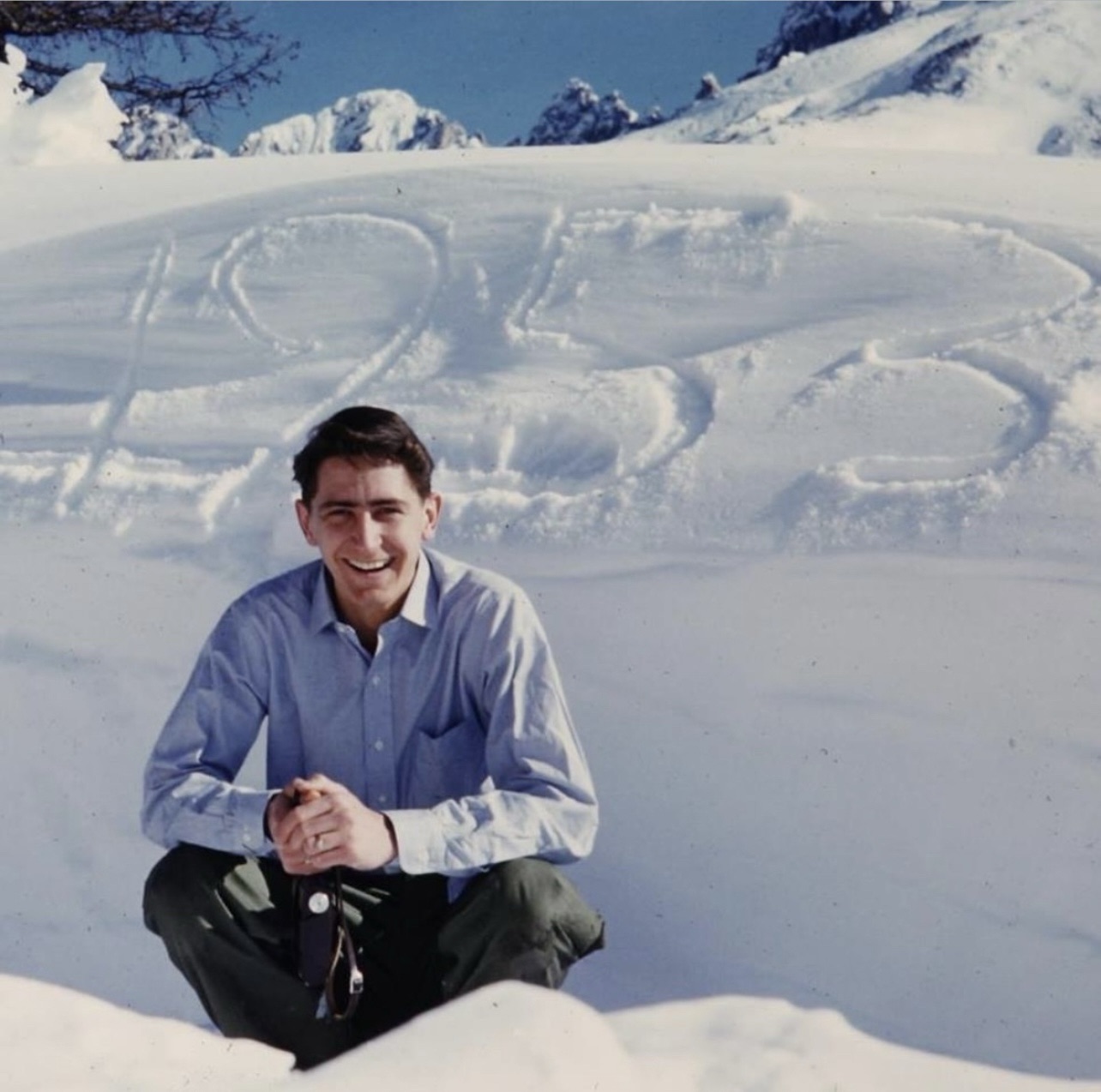
Always wanted to know what adventure my dad was on in this photo! Looks quite exciting!